What Is AI (Artificial Intelligence)?
“AI will never replace teachers, but it might help them grade homework faster than coffee ever could.”
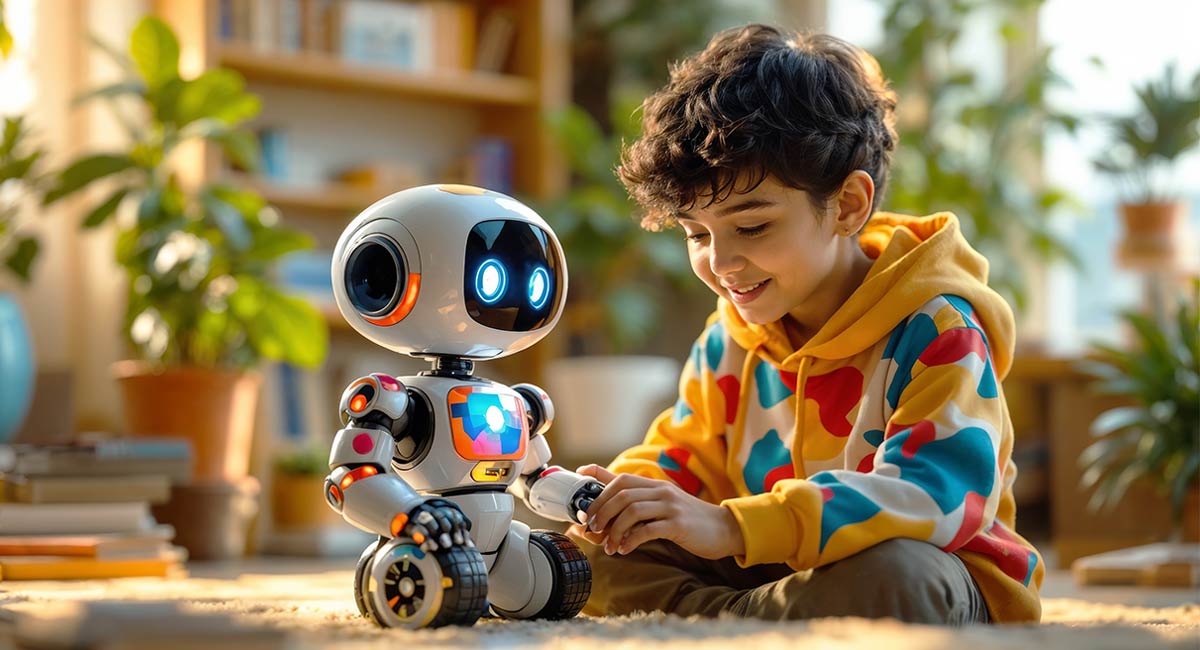
Artificial intelligence in kids’ learning is similar to having a super-smart assistant at your every beck and call who is tuned to your needs and wants, who is always patient and undeterred by your never-ending demands, and who can be compared to having a super-smart assistant, someone who never forgets a lesson and somehow remembers exactly what a child needs help with. These complexly designed systems and programmes are thus modelled to understand human languages and recognise images and visual patterns, solve your most complex problems, and always assist you in making even the smallest decisions of your daily life. Their real strength lies in how they adapt to each learner. One child might receive extra practice on fractions, while another learns history through engaging story-based games. With interactive apps and thoughtful learning platforms, AI shapes lessons to feel personal, matching each child’s pace, style, and interests.
Benefits of AI for Early Learners
1. Personalised Learning Paths
Children learn at different speeds and in different ways. AI-based platforms can assess a child’s progress and adjust lessons to suit their needs. For example, if a child finds multiplication difficult, the system may provide extra practice questions or break the topic into smaller, more manageable steps. This approach reduces frustration and ensures that no learner feels left behind.
2. Engaging and Interactive Learning
Children tend to learn better when they are actively interested in the content. AI tools make lessons lively through colourful animations, interactive games, and short quizzes. For example, language-learning apps can use voice recognition to check pronunciation and provide instant feedback. These features make studying feel less like a chore and more like play.
3. Detecting Learning Gaps Early
Small learning gaps can turn into bigger problems if they go unnoticed. AI can monitor a child’s performance over time and identify areas where they repeatedly struggle, such as spelling or solving certain types of maths problems. This allows teachers and parents to step in early and offer extra support before the issue grows.
4. Support for Special Educational Needs
Children with learning difficulties such as dyslexia or ADHD can benefit greatly from AI. Tools with text-to-speech (which reads words aloud), speech-to-text (which types spoken words), and visual aids can make lessons more understandable. These features ensure that every child has equal opportunities to learn and succeed.
5. Boosting Independent Learning Skills
Having the freedom to explore lessons at their own pace helps children feel more confident in their abilities. AI tools encourage them to find solutions on their own rather than relying entirely on an adult. Over time, this nurtures curiosity and strengthens problem-solving skills that are useful both inside and outside the classroom. This balance of guided and independent learning sits at the heart of our primary school approach.
Risks & How to Mitigate Them
1. Overreliance on Technology
Studies have shown that 54% of educators have noticed students becoming overly dependent on digital tools, which can reduce their ability to think independently. This is why artificial intelligence in kids’ learning should be combined with traditional teaching techniques that focus on reasoning, creativity, and practical problem-solving.
2. Data Privacy Concerns
Only about 35% of educational AI platforms fully meet international data protection standards such as GDPR. This means sensitive information like a child’s progress reports or voice recordings could be at risk. Parents should look for platforms that are transparent about data use, anonymise personal details, and use strong encryption for storage.
3. Reduced Social Interaction
Spending too much time on individual AI-based lessons can limit opportunities for children to develop communication and teamwork skills. Research indicates that using digital learning platforms for more than three hours daily can increase the risk of weaker social skills by 25%. Including group activities, collaborative projects, and in-person discussions helps maintain social growth.
4. Managing Screen Time
The World Health Organisation recommends that children aged 5 to 17 have no more than two hours of recreational screen time each day. Exceeding this limit can increase the risk of sleep problems by 43% and eye strain by nearly 30%. Parents can manage this by setting time limits, encouraging regular breaks, and balancing online lessons with offline activities like outdoor play, reading, or creative hobbies.
Practical Tips for Parents
1. Choose Reliable Platforms
Research the tool before introducing it to your child. Read reviews, check if its content matches your child’s syllabus, and confirm that it follows strong privacy protections. Free apps may look appealing, but often contain advertisements or collect unnecessary personal data.
2. Maintain a Balance Between Online and Offline Learning
AI works best when it complements real-life experiences. Encourage your child to mix digital learning with reading physical books, doing science experiments at home, or exploring nature.
3. Stay Involved in the Process
Being present during some of your child’s AI sessions can help you understand the tool better. It also makes children feel supported and more confident in asking questions.
4. Encourage Critical Thinking
When AI gives an answer, ask your child to explain it in their own words or relate it to a real-life situation. This ensures a deeper understanding rather than rote memorisation.
5. Track Progress Together
Most AI platforms provide detailed progress reports. Reviewing these with your child allows you to celebrate achievements together and focus on areas that need more attention.
The real value of AI is understood when it shows incredible application and efficiency in working alongside real teachers in their academic tasks, organises the moments perfectly to warm a family gathering, and works tirelessly to forge real-time experiences beyond screen life for you. Artificial intelligence in kids’ learning is often said to hold the potential to actually revolutionise the educational field and to turn it into a more engaging and accessible platform that also works to bring up truly personalised experiences for each learner if used wisely. For the parent, in deep bewilderment over the use of AI in their children’s lives, all that needs to be remembered is that AI is just like caffeine; it should first wake you up to countless possibilities and then assist you in exploring them. At Vishwajyot School, technology is used to support our teachers, never to replace the human side of learning.