After a school day, children step through your front door, their minds still buzzing with curiosity and their bodies brimming with energy. These precious hours in the afternoon are essentially needed for the apt inquiry of our children’s potential in different fields of talents, to discover their interests, and to let them create memories for a lifetime. The best after-school activities for children can turn ordinary afternoons into extraordinary adventures of learning and discovery, something to set the foundations of their lifelong passions and skills that will serve them well beyond childhood. At Vishwajyot School, these after-school hours are treated as a real part of how a child grows.
Creative Arts
There’s something truly magical when you get to see your child’s face light up when they create something of their very own. Creative arts activities help children express feelings, which they have not yet verbalised, while at the same time assisting them in developing their fine motor skills and boosting their unknown inner confidence.
Art and Craft Sessions:
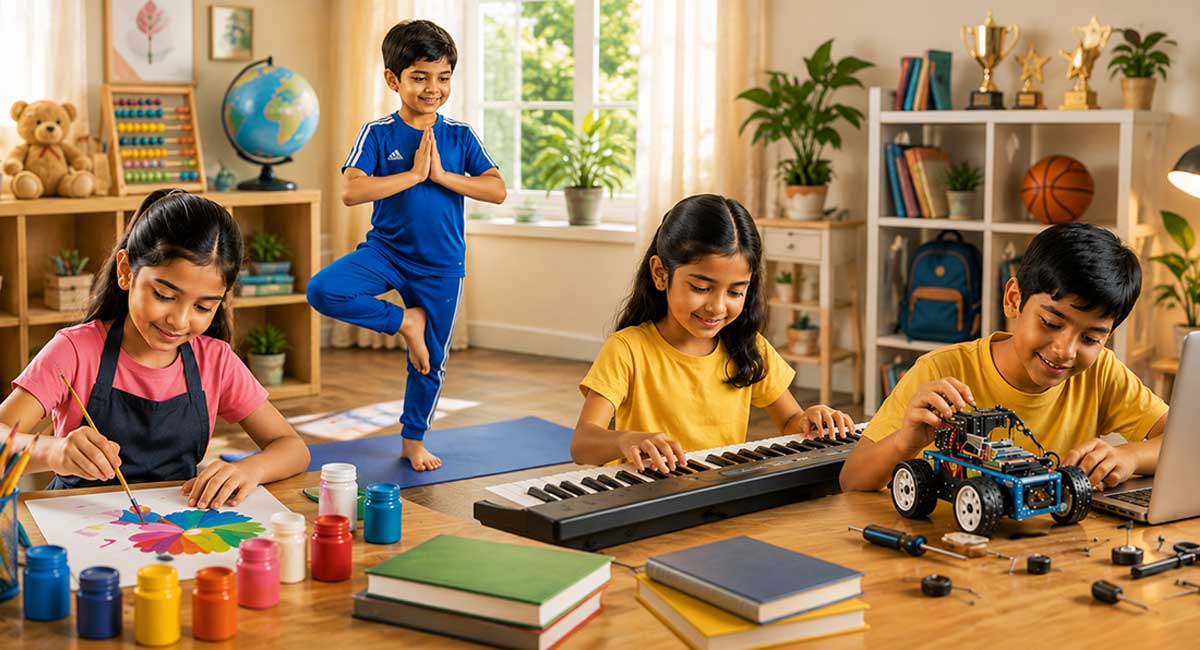
- Painting and Drawing: There’s nothing quite like setting up a cosy artistic place at home where your kid could dive into the world of watercolours and crayons for hours. You’ll watch as they discover how, by mixing blue and yellow, one can quickly create the most amazing green colour, or how their faces will light up after completing their first scenery paintings. These moments aren’t just about making pretty pictures but about allowing them to communicate the emotions that they may be unable to verbalise as of now.
- Clay Modelling and Sculpture: When a kid is playing with clay, notice how focused they seem. Their little hands seem to get stronger with each squeeze and roll, while their young brains start conjuring up thoughts to build some three-dimensional wonders. And honestly, it is quite heartwarming seeing their teeny not-a-dinosaur or that imaginary castle that keeps falling, because our hearts know how through this they’re learning how patience and attention to detail can create something truly special.
- Music and Performance: Kids who play basic instruments such as the ukulele, keyboard, or tabla and flute are not only learning the key basics of music but are also getting familiar with the moods of rhythm and melody and, essentially, the joy of making music together.
Sports & Movement
Physical activity after school isn’t just about burning off energy, but is also a welcome benefit to supporting to some of their essential developmental and emotional needs. Through movement, children develop coordination, learn teamwork, and build healthy habits that could continue to tag along with them throughout their lifetime.
Individual Sports Focus:
- Swimming: Swimming builds their entire body strength as well as teaches them essential water safety skills. It is often seen how many children relish the gentle rhythm of swimming that works wonders in relaxing their bodies after a tiring school day.
- Martial Arts (Karate, Taekwondo): If you want to see your child stand a little taller and speak a little more confidently, martial arts might be perfect for them. But there are some other key benefits of martial arts too, beyond the known physical prowess; these could include learning respect, self-control, and discipline, something sought in all aspects of one’s life.
- Team Sports Adventures: Cricket, basketball, and volleyball are some of the few such examples of team sports through which kids can learn the skills of collaboration, communication, and healthy competition. By participating in such activities, children develop the ability to embrace victory without being condescending, overcome defeat while holding onto their dignity, and support teammates through good or bad times.
STEM Explorations
The best after-school activities for children need to be fun and educational at the same time, and STEM activities are designed to provide that exact solution. These activities not only cater to the child’s inquisitive nature but also instil in them essential critical thinking and problem-solving skills in the process.
Science Experiments, Discovery, and Technology:
- Kitchen Chemistry: You can transform your kitchen into a mini laboratory, allowing your little one to be the master chef scientist for the afternoon. When they mix baking soda with vinegar and watch it fizz and bubble, the moment itself will open their eyes wide with astonishment at the ‘magic’ of basic chemistry. It will start with the excitement of making colourful slime, soon peaking into the restlessness of creating their own mini volcanoes.
- Nature Studies: You can take these little explorer minds for strolls around the neighbourhood and gardens. The simple acts of collecting leaves and running and playing on the grass, observing the weather, and engaging with nature work in ways that screen time simply can’t provide for their developing minds.
- Building and Construction: Kids often turn into little engineers with LEGO bricks, magnetic tiles, and cardboard boxes. Essentially, through this process, they figure out how to design their mega-creations, test their ideas, make improvements when things don’t work, and most importantly, keep trying when their first attempt hasn’t turned out exactly as they had imagined.
Mindfulness Skills
In our fast-paced world, teaching children to slow down and connect with themselves could be easily noted as the most valuable life lesson to support their emotional well-being for their entire lives. These mindfulness activities help in regulating our emotions and tuning down our stressful lifestyles.
- Meditation and Breathing Exercises: By following simple guided meditation, designed for children and their age, they often nurture visualisation and core-strengthening in them. These activities also help develop focus and calmness in our children. You can always start by teaching your ward some basic breathing techniques that they can use whenever they feel overwhelmed or anxious.
- Journaling and Reflection: You can encourage your child to write or draw three things they’re grateful for each day. You might be surprised by how sincere and honest the answers they give are. For them, these could be the most wonderful parts of their day or just something that makes them feel like “the king of the world.” This simple practice helps to build positive thinking patterns in their young minds and, over time, could also turn into that small place of genuine reflection that they would crave to visit every day.
Choosing the Right Activity
The best after-school activities for children will be the ones that you pick, understanding your child’s unique personality and your family’s practical necessities. Usually, introverted children often thrive in quieter pursuits such as art or individual sports, while extroverted kids are often inclined to team activities and group projects. Your decision should also be based on your family’s schedule, transportation logistics, and budget when making choices. The best after-school activities for children should essentially be a balance of physical activity, creative expression, and quiet reflection time. However, most importantly, remember to avoid over-scheduling, as children often prefer unstructured moments to process their day, play freely, and simply be kids. Many of these activities also run as structured sessions through the school day at our primary school.
Those bustling after-school hours don’t have to be that stressful or chaotic. With the best after-school activities for children, you can witness their post-school energy transform into something wonderful. This could be anything, from your child discovering they love painting to becoming obsessed with science experiments or discovering their talent on the cricket field. It will only be these afternoon adventures that will remain after a while, which you’ll witness your children grow into with confidence and joy and the best thing is that you don’t need to have it all figured out right away. You can choose one activity that sounds fun, see how it goes, and remember that childhood is meant to be enjoyed one afternoon at a time.